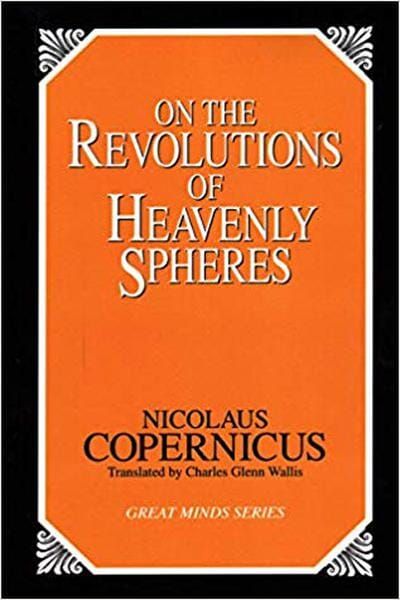
On the Revolutions of Heavenly Spheres Book Summary
By Nicolaus Copernicus
Published: 1995

Start Listening to Book Summary
Book Review of On the Revolutions of Heavenly Spheres
The Ptolemaic system of the universe, with the earth at the center, had held sway since antiquity as authoritative in philosophy, science, and church teaching. Following his observations of the heavenly bodies, Copernicus abandoned the geocentric system for a heliocentric model, with the sun at the center. This book stands as one of the supreme monuments of science. It led to one of the greatest intellectual revolutions of all time, and profoundly influenced, among others, Galileo and Sir Isaac Newton.
Book Overview of On the Revolutions of Heavenly Spheres
About the Book Author
Nicolaus Copernicus
Nicolaus Copernicus (1473-1543) was a Renaissance mathematician and astronomer who is best known for his seminal work, "De revolutionibus orbium coelestium" (On the Revolutions of the Celestial Spheres), published in 1543. This groundbreaking treatise formulated the heliocentric model of the universe, positing that the Earth and other planets revolve around the Sun, which challenged the long-standing geocentric view held since antiquity. Copernicus's writing is marked by a meticulous and methodical approach, grounded in mathematical rigor and observational accuracy. His ideas laid the foundation for the Scientific Revolution and profoundly influenced subsequent thinkers such as Galileo and Kepler, reshaping our understanding of the cosmos.
Book Details
Key information about the book.
- Authors
- Nicolaus Copernicus
- Published
- January 1995
- Publisher
- Great Minds Series
- ISBN
- N/A
- Language
- English
- Pages
- 360
- Genres
- History of ScienceScience and Nature
Purchase Options
 Buy on Amazon
 Buy via BookShop
Support local bookstores: BookShop gives a portion of each sale to independent bookshops!
Similar books you might like →
The Structure of Scientific Revolutions Book Summary
In "The Structure of Scientific Revolutions," Thomas S. Kuhn challenges the traditional view of scientific progress, arguing that it unfolds not through a linear accumulation of knowledge but via transformative paradigm shifts. He illustrates how revolutions in thought disrupt the established scientific order, forever altering the way we understand the world. Kuhn's compelling concept of "normal science" is juxtaposed with revolutionary breakthroughs that redefine entire fields. This thought-provoking exploration raises essential questions about the nature of truth and the progress of human knowledge. Discover how scientific advancements are less about discovery and more about evolution in thought, sparking curiosity about what radical shifts lie ahead.
A Brief History of Time Book Summary
In "A Brief History of Time," Stephen Hawking takes readers on a captivating journey through the cosmos, exploring the nature of time, black holes, and the universe's beginnings. With stunning clarity, he unravels complex scientific concepts, inviting everyone—from curious laypersons to seasoned physicists—to ponder the mysteries of existence. Hawking's charismatic storytelling challenges our perceptions of reality and time itself, posing profound questions about the universe's fate. As he merges science with philosophy, the reader is compelled to reflect on their place in a vast, enigmatic cosmos. Prepare to be inspired and awed by a narrative that transcends mere facts, pushing the boundaries of human understanding.
Three Scientists and Their Gods Book Summary
In 'Three Scientists and Their Gods', Robert Wright explores the profound connections between science, religion, and the human experience. He delves into the lives and thoughts of three pivotal figures—Albert Einstein, Charles Darwin, and Isaac Newton—revealing how their groundbreaking ideas reshaped our understanding of the universe. Through a captivating narrative, Wright challenges the dichotomy between faith and reason, urging readers to consider the spiritual implications of scientific discoveries. With philosophical depth and historical insight, the book raises tantalizing questions about the nature of existence and the divine. Are our beliefs about God shaped by our scientific understanding, or is there something more? Discover how these monumental thinkers grappled with the mysteries of life.

The Making of the Atomic Bomb Book Summary
In 'The Making of the Atomic Bomb,' Richard Rhodes unveils the gripping narrative behind one of history's most monumental scientific achievements. With a blend of meticulous research and compelling storytelling, Rhodes explores the lives of the brilliant minds and the moral dilemmas they faced while racing against time and adversaries. As the project transforms from a theoretical concept to a world-altering weapon, readers are drawn into the political intrigue and human drama that fueled the Manhattan Project. This book not only delves into the science of atomic energy but also poses profound questions about human ambition and ethical responsibility. What does it mean to wield such immense power, and at what cost does progress come?

A Comprehensive Introduction to Differential Geometry Book Summary
Dive into the intricate world of differential geometry with Michael Spivak's enlightening guide. This comprehensive introduction marries rigorous mathematical theory with captivating insights, unraveling the complex structure of curves and surfaces. Spivak's clear exposition invites readers to explore the elegant dance between mathematics and the physical universe. Whether you're a budding mathematician or a curious mind, you'll find yourself immersed in profound concepts that reveal the beauty of geometry. Join the journey to understand how curvature shapes the fabric of space itself!

QED and the Men who Made it Book Summary
In 'QED and the Men who Made it', Silvan S. Schweber delves into the intricate world of Quantum Electrodynamics (QED), revealing the visionary scientists behind its development. Through vivid storytelling, Schweber intertwines personal anecdotes with historical milestones, bringing to life the passionate debates and groundbreaking discoveries that reshaped modern physics. The book highlights not only the scientific breakthroughs but also the human drama and intellectual struggles that accompanied them. As Schweber unpacks the mathematical elegance of QED, readers are invited to ponder the mysteries of the universe and the quest for understanding. This captivating narrative is sure to leave you questioning the very fabric of reality.

36 Lectures in Biology Book Summary
No summary available
A History of Economic Theory Book Summary
In 'A History of Economic Theory', Jürg Niehans takes readers on a captivating journey through the evolution of economic thought. From ancient philosophies to contemporary paradigms, the book unravels how ideas have shaped economic practices across cultures and eras. With each chapter, Niehans reveals the intellectual battles and breakthroughs that have defined the discipline. Rich in historical context, this work challenges readers to consider the relevance of past theories in today's economy. Dive into this scholarly adventure and discover how the past continually influences our understanding of wealth and value.
Showing 8 of 30 similar books
Take your reading experience to the next level
Download our mobile app to enjoy your favorite books on the go. Get access to exclusive features, offline listening, and personalized recommendations.

Similar Book Recommendations →

Amanda Palmer's Book Recommendations
Amanda Palmer is an American singer-songwriter, author, and performance artist, best known for her work as a solo artist and as part of the band The Dresden Dolls. Palmer is known for her theatrical performances, genre-blending music, and her strong connection with her fanbase. She has been a pioneer in crowdfunding, raising millions to fund her creative projects through platforms like Kickstarter and Patreon. Palmer is also the author of The Art of Asking, where she explores themes of vulnerability, creativity, and connection. Her work transcends traditional music, blending performance art, activism, and community engagement.

Chris Dixon's Book Recommendations
Chris Dixon is a notable venture capitalist and technology entrepreneur, best known for his influential role as a general partner at Andreessen Horowitz, where he leads investments in cryptocurrency and blockchain technology. Before joining the firm, Dixon co-founded two startups: SiteAdvisor, a web security company acquired by McAfee, and Hunch, a recommendation engine acquired by eBay. In addition to his investment career, Dixon is a prolific writer and thought leader on technology and innovation, contributing insightful essays and articles to various platforms such as his personal blog and Medium. His writings often explore the future of technology, the internet, and the impact of blockchain, making significant contributions to contemporary tech literature. Dixon's work has earned him recognition as a visionary in both the tech and literary worlds.

Bret Victor's Book Recommendations
Bret Victor is a renowned American interface designer and computer scientist celebrated for his innovative contributions to interactive design and human-computer interaction. He is best known for creating dynamic, explorable explanations, which have significantly influenced the way educational content is presented and understood. Victor's seminal work, "Inventing on Principle," advocates for the integration of immediate feedback in creative processes, inspiring a new wave of interactive programming environments. As a former member of the Apple Human Interface team, he played a pivotal role in shaping modern user interfaces. Through his organization, Dynamicland, Victor continues to explore and expand the boundaries of immersive, collaborative computing environments.

Bryan Johnson's Book Recommendations
Bryan Johnson is an American entrepreneur, investor, and futurist, best known for founding Braintree, a payments company that was acquired by PayPal, and Kernel, a company focused on developing brain-computer interfaces. Johnson is deeply interested in advancing human cognition and longevity through technological innovation. His work at Kernel seeks to better understand the brain and its potential to enhance human intelligence. He is also the founder of OS Fund, which invests in companies tackling complex, world-changing problems in areas like health and energy. Johnson is a strong advocate for using technology to extend human potential and reshape the future of humanity.

Brian Earp's Book Recommendations
Brian Earp is a distinguished ethicist and interdisciplinary researcher, renowned for his extensive work in medical ethics, philosophy, and psychology. He serves as the Associate Director of the Yale-Hastings Program in Ethics and Health Policy at Yale University. Earp has co-authored several influential books, including "Love Drugs: The Chemical Future of Relationships," which explores the ethical implications of using pharmaceuticals to enhance romantic relationships. His scholarly articles have been widely published in leading academic journals, making significant contributions to debates on bioethics, sexuality, and human enhancement. Earp is also recognized for his engaging public outreach, effectively bridging the gap between academic research and public discourse.

Charlie Munger's Book Recommendations
Charlie Munger is an American investor, businessman, and philanthropist, best known as the vice chairman of Berkshire Hathaway, where he partners with Warren Buffett. Renowned for his insights on investment strategies and mental models, Munger has significantly influenced the world of finance. His notable literary contributions include "Poor Charlie's Almanack," a compilation of his speeches and writings that distill his wisdom on decision-making and business principles. Munger's work emphasizes the importance of multidisciplinary thinking and continuous learning. Beyond his financial acumen, he is celebrated for his charitable efforts, particularly in education and healthcare.

Jamie Dimon's Book Recommendations
Jamie Dimon is an American business executive, best known as the Chairman and CEO of JPMorgan Chase, one of the largest and most influential financial institutions in the world. Dimon has led JPMorgan through multiple economic crises, including the 2008 financial crash, and has consistently been recognized for his leadership in the banking industry. Under his tenure, JPMorgan has grown into a global financial powerhouse, focusing on innovation and sustainability. Dimon is also an advocate for corporate responsibility and frequently speaks on economic and regulatory issues. His leadership style and strategic insights have earned him widespread respect in the business world.

Chamath Palihapitiya's Book Recommendations
Chamath Palihapitiya is a prominent venture capitalist, entrepreneur, and the founder of Social Capital, a firm that aims to advance humanity by solving complex societal problems. Although primarily known for his investments in companies like Slack and Box, Palihapitiya is also a vocal advocate for technology's role in societal improvement. He has contributed thought-provoking essays and articles on economic inequality, healthcare, and education reform, influencing public discourse and policy. His visionary ideas are often shared through platforms like Medium and various keynote speeches. Palihapitiya's multifaceted career underscores his commitment to leveraging technology for social good.
Showing 8 of 14 related collections
Frequently Asked Questions
Explore Our Catalogue
Discover a world of knowledge through our extensive collection of book summaries.
Genres
Genres
Genres
Featured Collections
- Top Book Club Picks
- One-Stop Nutrition
- Summer Reads 2024
- Best Beach Reads 2024
- Work-Life Balance Guide
- Time Management
- Healthy Foods
- Entrepreneur Toolkit
- Mind & Body Wellness
- Future Tech Insights
- Leadership Essentials
- Financial Freedom
- Sci-Fi Masterpieces
- Parenting 101
- Books That Became Blockbusters
- Guide to a Healthy Pregnancy